

Phones went off first.
That is how most people in Tokyo learned about it – a harsh, unmistakable alarm from the bedside table, five or six seconds before anything actually moved. Then the room started swaying. Not a sharp bang, but a long lateral roll that carried on for close to a minute in some wards.
It was 2 a.m. on Sunday, 23 August 2026. Almost everyone was asleep.
By breakfast, the Japan Meteorological Agency had put the number at magnitude 5.9, with the focus roughly 68 to 70 kilometres beneath southern Ibaraki Prefecture, northeast of the capital. The United States Geological Survey logged the same event a little differently – magnitude 5.8, depth around 61 kilometres, centred about four kilometres north of the city of Toride. That kind of small disagreement between agencies is routine; they run different sensor networks and different magnitude formulas.
At least 37 people were hurt across five prefectures. Not one of those injuries came from a building failing. That detail is, genuinely, the entire story.
The Fast Facts
| Date & time | Sunday, 23 August 2026, approx. 02:00 JST |
| Magnitude | 5.9 (JMA) / 5.8 (USGS) |
| Epicentre | Southern Ibaraki Prefecture, near Toride |
| Depth | ~68–70 km (JMA) / ~61 km (USGS) |
| Fault mechanism | Reverse faulting (compression) |
| Max shaking | Lower 5 on the shindo scale |
| Tsunami | None. No advisory issued |
| Injuries | At least 37, across 5 prefectures |
| Fatalities | None reported |
| Nuclear facilities | No abnormalities reported |
What Actually Happened Across the Kanto Region
The strongest shaking lower 5 on Japan’s seven-point shindo scale was recorded in Tokyo’s Adachi Ward and in parts of Ibaraki, Saitama and Chiba. Most of the rest of Tokyo, plus Tochigi, Gunma and Kanagawa, registered a 4.
Tokyo’s 23 wards, Saitama and Chiba also picked up Level 2 long-period ground motion. That is the slow, rolling movement that high-rise towers amplify — the reason people on the 30th floor of a Shinjuku building often report a far nastier experience than someone at street level a kilometre away.
The damage was almost entirely mundane, and that is worth sitting with:
- An underground water pipe ruptured in the Kiyosumi area of Koto Ward, eastern Tokyo, flooding a stretch of road. Tokyo Fire Department crews were on the street before dawn. Additional pipes burst elsewhere in the region.
- Part of a ceiling came down inside the city hall building in Ushiku, Ibaraki.
- Roughly 460 homes in Tokyo lost power, according to TEPCO Power Grid.
- People were briefly trapped in lifts across the capital.
- JR East reported delays across the Joban, Keihin-Tohoku, Shonan-Shinjuku, Musashino, Chuo-Sobu and Sotobo lines, plus the express services running out to Narita Airport. Shinkansen bullet trains ran normally.
Prime Minister Sanae Takaichi announced a government task force on X within the hour. The Nuclear Regulation Authority checked roughly a dozen facilities and found nothing out of order — including the Tokai No. 2 plant in Ibaraki, the Tokai plant currently being decommissioned, and the Fukushima Daiichi and Daini sites further north.
Why the Injury Count Kept Climbing
Early wire copy said 23 injured. By mid-morning it was 37. If you were refreshing news sites, that jump probably looked alarming.
It wasn’t. Japan’s Fire and Disaster Management Agency compiles casualty figures from prefectural fire departments as they report in, so the number rises through the morning as paperwork catches up. The breakdown settled at roughly 15 in Tokyo, nine in Saitama, eight in Kanagawa, four in Chiba and one in Ibaraki.
And the nature of the injuries matters more than the count. People fell out of bed. People walked into doors and furniture in a dark room while half-awake. The most serious case reported was a woman in her eighties in Yokohama who fell from her bed and suffered a hip injury.
Nobody was crushed. Nothing collapsed on anyone.
Magnitude vs Shindo: The Distinction That Confuses Almost Everyone
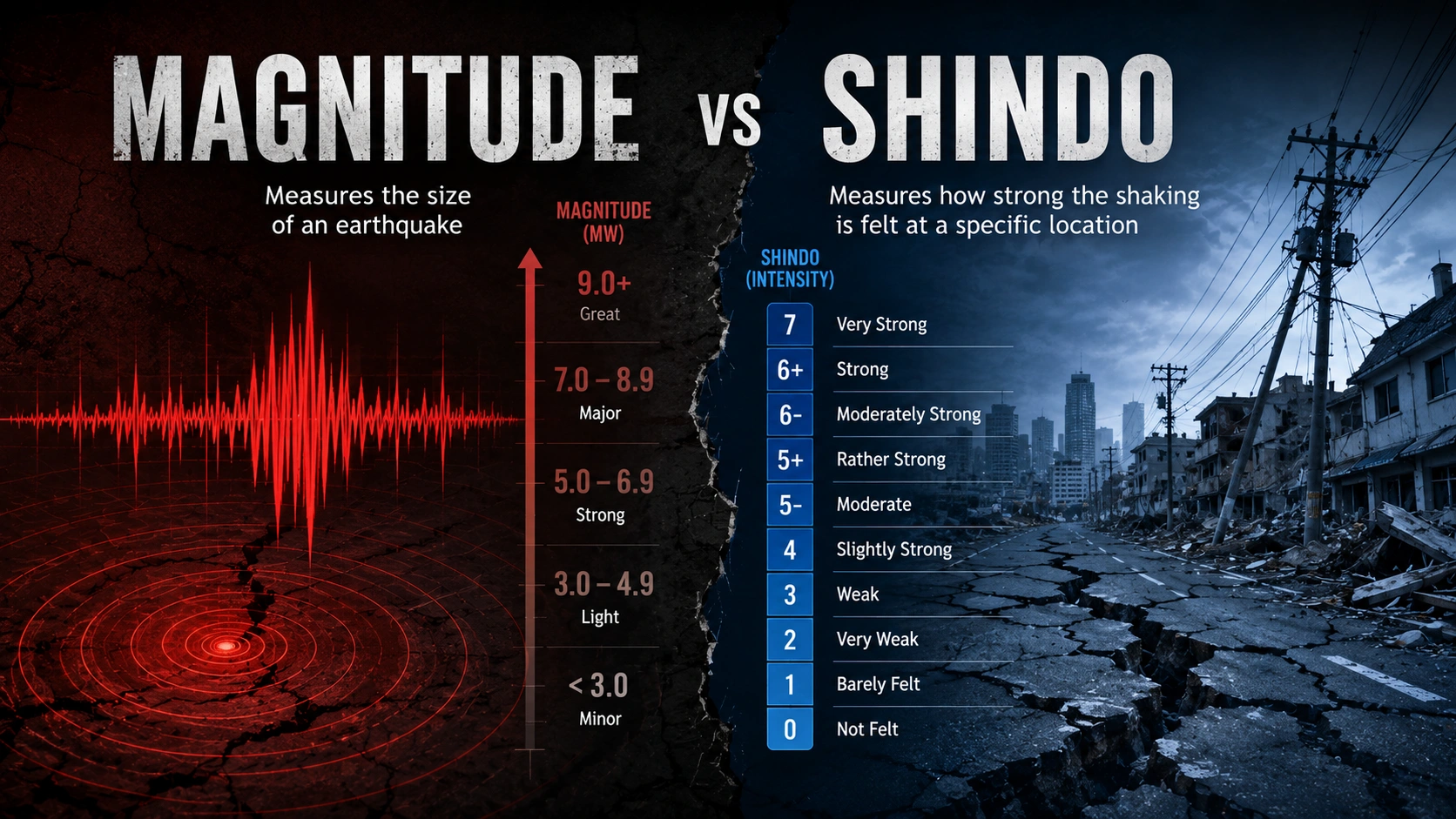
If you searched for this quake, you probably saw two different numbers and wondered which one was real. Both are.
Magnitude measures how much energy the fault released. It is one number for the whole earthquake, and it tells you nothing about what you personally felt.
Shindo — Japan’s seismic intensity scale – measures what the ground actually did at a specific location. It runs 0, 1, 2, 3, 4, lower 5, upper 5, lower 6, upper 6, 7. Ten steps, not seven numbers.
Every location gets its own shindo reading. That is why one quake produces a map of values rather than a single figure.
Here is what the middle of the scale means in practice, per JMA:
| Shindo | What it feels like |
|---|---|
| 4 | Hanging objects swing hard. Sleeping people wake up. Unstable ornaments may topple. |
| Lower 5 | Objects fall off shelves. Most people reach for something to steady themselves. Unsecured furniture starts moving on its own. |
| Upper 5 | Unsecured furniture topples. Windows may break. Poorly reinforced walls crack. |
| Lower 6 | Difficult to remain standing. Heavy furniture moves across the room. Weaker buildings sustain real damage. |
Sunday’s quake reached lower 5. That is precisely the threshold where bookshelves walk, televisions slide off stands, and dishes come out of cabinets which is exactly the injury pattern the hospitals recorded.
A magnitude 5.9 at 70 kilometres depth also explains the absence of a tsunami. Tsunamis require the seafloor itself to move vertically. A quake this size, this far underground, and this far inland simply doesn’t displace enough water to generate one.
Why Tokyo Keeps Shaking
Tokyo sits on one of the most tectonically complicated pieces of ground on Earth.
The Kanto plain is where the Pacific plate, the Philippine Sea plate and the Eurasian plate all converge. Research published through the USGS goes further, proposing that a dislodged fragment of the Pacific plate is jammed beneath Kanto — and that this “Kanto fragment” governs much of Tokyo’s behaviour during larger earthquakes.
The practical consequence is relentless background seismicity. According to earthquake-monitoring data compiled by EarthquakeList, roughly 2,530 quakes of magnitude 4 or above have occurred within 300 km of Tokyo over the past decade. That averages out to about 253 a year, or one every day or two.
Most are never felt. A handful each year are felt clearly. Perhaps one or two are strong enough to make the international news.
Which is a useful frame for Sunday: this was not an anomaly. It was a Tuesday-morning event that happened to land at 2 a.m. on a Sunday, in the country’s most-photographed city, during a year when Japan has already had a very bad run.
2026 Has Been a Heavy Year
Context matters here, because Sunday’s quake did not arrive in a vacuum. Japan has absorbed three significant events in the past five months alone:
20 April 2026 — Sanriku, M7.5. Struck along the Japan Trench off the Sanriku coast. Damaged 233 structures, generated an 80 cm tsunami, injured 10.
25 June 2026 — off Iwate, M7.2. Initially read as 6.9, later upgraded. Depth around 50 km. Hit during Thursday morning rush hour and produced mild shaking as far as Tokyo. No tsunami, no reported injuries.
28 July 2026 — Kumamoto, M7.1. By far the worst. The quake struck Japan’s southernmost main island of Kyushu and killed 38 people, injured 364, destroyed more than 1,500 buildings and damaged nearly 20,000 others.
Set against a magnitude 7.1 that killed 38 people less than a month earlier, a magnitude 5.9 with 37 minor injuries reads very differently. The energy difference between the two is not small — each full step up the magnitude scale represents roughly 32 times more energy released.
“Stay Alert for a Week” – What the JMA Warning Actually Means
After the shaking stopped, the JMA issued its standard advisory: residents in areas that felt strong shaking should stay vigilant for the possibility of similar shaking over roughly the next week.
This gets misread constantly. It is not a prediction. Nobody can predict earthquakes, and JMA does not claim to.
It is a statement about statistics. Aftershock sequences follow a well-documented decay pattern — the probability of another notable quake in the same area is measurably elevated immediately afterwards and drops off over days. The one-week window is a conservative bracket drawn around that curve.
What it means in practice: secure anything that fell over, don’t sleep under a heavy bookshelf you’ve been meaning to bolt to the wall, and check your torch works. It does not mean a bigger quake is coming.
The Question Underneath All of This
Every time Tokyo shakes, the same search spike follows: is this the big one, and when is it coming?
The honest answer is that Japan’s government has already published its estimate, and it is sobering.
The Earthquake Research Committee puts the probability of a magnitude 7-class earthquake striking the southern Kanto region including Tokyo at roughly 70% within 30 years.
In December 2025, the government released a revised damage projection for that scenario. A magnitude 7.3 quake directly beneath the capital, in a worst-case configuration, was estimated to cause around 18,000 deaths and up to ¥83 trillion (roughly $535 billion) in economic damage, destroying some 400,000 buildings and leaving 8.4 million people unable to get home.
For historical calibration: the 1923 Great Kanto Earthquake, magnitude 7.9, killed somewhere between 105,000 and 140,000 people — most of them not in the collapse itself but in the firestorms that swept Tokyo and Yokohama afterwards.
So why did Sunday’s quake injure 37 people instead of 3,700?
Because Japan spent a century responding to 1923. Building codes tightened after every major disaster — 1950, 1971, 1981, and again after Kobe in 1995. The 1981 revision in particular drew a hard line: structures built to the shin-taishin standard are engineered to survive shindo 6 to 7 without collapsing. Retrofit programmes have worked steadily through the older stock ever since.
Add the earthquake early warning system which detects the fast-moving P-wave and pushes an alert to every phone in the affected area seconds before the destructive S-wave arrives — and you get Sunday’s outcome. A city of 37 million rolled through a lower-5 event and went back to sleep.
That is not luck. That is a hundred years of engineering, funding and enforcement.
If You’re In Tokyo: What to Actually Do
Practical, in the order that matters.
During the shaking Drop, cover, hold on. Get under a sturdy table if one is nearby. Protect your head with a cushion or your arms if not. Stay away from windows and anything tall and unsecured. Do not run outside — falling glass and masonry are the danger, and Japanese buildings are the safe place, not the risk.
Immediately after Turn off gas at the main if you smell anything. Open a door or window to secure an exit route. Put on shoes before you walk anywhere — broken glass causes a large share of post-quake injuries. Check on elderly neighbours.
Prepare before, not during This is where most of the injury risk actually lives. Bolt tall furniture to the wall using L-brackets or tension rods. Fit latches on cabinet doors. Never place heavy items on high shelves, and never position a bed directly beneath one. Keep a torch and shoes within arm’s reach of where you sleep – Sunday’s 2 a.m. timing is exactly why.
Keep a bag ready Water, non-perishable food, a portable battery, a torch, a whistle, basic first aid, copies of your passport or residence card, and cash. Japanese ATMs and card terminals depend on power.
If you’re visiting Download the official JNTO Safety Tips app before you land. It pushes earthquake early warnings, tsunami alerts and evacuation advice in English, Chinese, Korean and other languages. Note the designated evacuation area nearest your hotel — every ward publishes them. Japanese hotels are held to the same seismic standards as everything else, so the correct response is almost always to stay put and follow staff instructions.
Where to Get Real Information
For anything time-sensitive, skip the aggregators and go to the source:
- Japan Meteorological Agency (JMA) – the official authority for magnitude, intensity and tsunami advisories, published in English at
jma.go.jp - NHK World-Japan – public broadcaster, English-language, fastest reliable live coverage
- USGS Earthquake Hazards Program – independent international confirmation
- JNTO Safety Tips app – push alerts for travellers
Two things to watch for during any quake in Japan. First, magnitude figures are almost always preliminary for the first several hours and get revised. Second, footage circulating on social media during a Japanese earthquake is very often recycled from a previous event — the 2011 Tohoku disaster in particular gets re-uploaded relentlessly. Check the source before you share it.
Frequently Asked Questions
Was there a tsunami warning after the Tokyo earthquake? No. The JMA issued no tsunami advisory. At magnitude 5.9 and a depth of around 70 kilometres, the quake did not displace enough seafloor to generate one.
How strong was the earthquake in Tokyo? Tokyo’s Adachi Ward recorded lower 5 on the shindo scale, with most other parts of the capital at 4. Lower 5 is strong enough to knock objects off shelves and force people to steady themselves.
Were there any deaths? No fatalities were reported. At least 37 people were injured across Tokyo, Saitama, Kanagawa, Chiba and Ibaraki mostly from falls and collisions with furniture in the dark, not from structural damage.
Are the trains running in Tokyo? Services were delayed or briefly suspended across several JR East lines in the early hours and were progressively restored through Sunday morning. Shinkansen bullet trains ran normally throughout.
Was Fukushima affected? No. The Nuclear Regulation Authority and plant operators reported no abnormalities at any nuclear facility, including Tokai No. 2 in Ibaraki and the Fukushima Daiichi and Daini sites.
Will there be an aftershock? The JMA advised residents in strongly shaken areas to stay alert for the possibility of similar shaking for about a week. This is a standard statistical advisory issued after any notable quake — not a prediction that another will occur.
How often does Tokyo get earthquakes? Very frequently. Roughly 250 quakes of magnitude 4 or above occur within 300 km of Tokyo each year, though the large majority are never felt by residents.
Is Tokyo safe to visit right now? Yes. Normal services resumed within hours. Japan enforces some of the strictest seismic building codes in the world and operates a nationwide early warning system. Travellers should download the JNTO Safety Tips app and note their nearest evacuation area.
When is the “big one” expected in Tokyo? Japan’s Earthquake Research Committee estimates a roughly 70% probability of a magnitude 7-class earthquake in the southern Kanto region within 30 years. No one can predict a specific date — earthquake forecasting remains probabilistic, not predictive.
The Takeaway
A magnitude 5.9 woke up 37 million people, injured 37 of them, broke a water main and delayed some trains. Then Tokyo got on with its Sunday.
That outcome was purchased. It was paid for in building codes rewritten after each disaster, in retrofit subsidies, in a sensor network dense enough to get an alert onto a phone before the ground moves, and in a population that has practised this since primary school.
The 70% figure still sits there. Tokyo knows it. That is precisely why Sunday looked the way it did – and why the boring, unglamorous work of bolting a bookshelf to a wall is the single most useful thing anyone reading this can act on.